

How To Master Calendering And Leveling Process Technology For Titanium Welded Tubes?
Sep 20, 2026
Leave a message

Compared with seamless titanium tubes, titanium welded tubes feature higher production efficiency, better yield and superior specification adaptability. Nevertheless, defects such as residual stress, misalignment and roundness deviation restrict their application in high‑end scenarios. As a critical finishing procedure, calendering and leveling correct dimensions, optimize weld seams and regulate residual stress through controlled plastic deformation, which exerts a direct impact on the quality and reliability of finished products.
I. Core Process Technologies for Calendering and Leveling of Titanium Welded Tubes
1. Process Principle
After roll forming, high‑frequency welding and weld bead removal, titanium welded tubes commonly suffer from poor roundness, raised weld seams, bending deformation and residual tensile stress. Calendering and leveling applies radial pressure via multiple sets of roller dies to induce slight and uniform plastic deformation of tubes, so as to calibrate roundness, flatten weld seams, relieve residual stress and mitigate cracking and stress‑corrosion risks.
2. Key Control Points
- Deformation amount
The total deformation is controlled within 0.5%‑3%. Given titanium's significant spring‑back, multi‑pass small reduction is adopted. Excessive deformation will result in out‑of‑tolerance wall thickness, surface peeling and micro‑cracks, while insufficient deformation leads to poor leveling performance.
- Roll profile and tension
Micro‑tension is applied to prevent tube twisting and deviation. Arc‑shaped roller surfaces avoid surface scratching. Weld seams shall be well‑aligned for uniform force distribution so as to prevent localized wall‑thickness reduction.
- Lubrication and protection
Special lubricants are used and roller surface roughness is strictly controlled. For high‑purity and medical‑grade titanium tubes, degreasing and cleaning shall be performed after processing to eliminate lubricant residues.
- Residual stress
Compressive surface stress introduced by calendering counteracts welding‑induced tensile stress. Low‑temperature leveling is acceptable for ordinary chemical‑use titanium tubes. For high‑corrosion‑resistant titanium tubes, low‑temperature stress‑relief annealing is required after leveling to improve stress‑corrosion resistance.
3. Process Difficulties
Large spring‑back of titanium makes single‑pass reduction inadequate for production requirements. Property differences between weld seams and base metal give rise to uneven deformation. Thin‑walled tubes are prone to collapse, which imposes high requirements on equipment synchronization accuracy.
II. Innovation Directions for Calendering and Leveling Equipment
1. Multi‑roll Servo‑Synchronized Calendering Unit
Multiple sets of independently servo‑driven pressure rollers replace conventional hydraulic systems, enabling micron‑level individual adjustment of reduction with synchronous linkage. It avoids collapse of thin‑walled titanium tubes and stabilizes production of small‑diameter thin‑walled titanium welded tubes. Pressure rollers are made of hot‑work die steel with DLC coating or nitriding treatment to reduce titanium sticking and extend roller service life.
2. On‑line Weld Seam Identification and Tracking System
Vision sensors track weld seams in real time, automatically adjusting roller posture and local reduction to precisely roll and flatten weld seams while restraining deformation of base metal. It prevents local over‑pressure and uneven wall thickness caused by weld‑seam offset, improves product consistency and adapts to high‑speed continuous production.
3. Closed‑loop Control System with Multi‑parameter On‑line Detection
Equipped with laser diameter measurement, ellipticity testing and surface visual flaw‑detection devices, the system collects real‑time data including outer diameter, roundness, straightness and surface defects. Collected data is fed back for dynamic adjustment of reduction, line speed and tension, forming a closed loop of "detection‑calculation‑adjustment". It replaces manual spot‑checking, reduces human errors and stabilizes batch product quality.
4. Integrated Cleaning Module
For high‑purity and medical‑grade titanium welded tubes, functions including on‑line purging, spray degreasing and drying are integrated at the calendering station. Leveling and surface cleaning are completed simultaneously to avoid contamination from secondary handling and satisfy cleanliness requirements for high‑end products.
III. Analysis on Application Value of the Technical System
1. Product Quality Value
Calendering and leveling improves roundness and outer‑diameter accuracy of titanium welded tubes, smooths weld seams and optimizes residual‑stress distribution, enhancing stress‑corrosion resistance and fatigue performance of finished tubes. Qualified products can be applied to heat exchangers and seawater pipelines, partially substituting high‑priced seamless titanium tubes and cutting material costs.
2. Industrial Economic Value
- Higher product yield: Rejection caused by weld‑seam defects, roundness errors and surface flaws is reduced, lowering titanium material consumption.
- Higher added value: Ordinary titanium welded tubes are mostly used for low‑end components. After calendering and leveling, they can serve high‑end fields such as marine equipment, nuclear power auxiliary pipelines, pharmaceutical equipment and high‑end heat exchange systems.
- Energy‑saving and mass‑production capability: Titanium welded tubes feature short production cycles and lower energy consumption compared with forging‑and‑piercing processes for seamless titanium tubes. Mass manufacturing can be realized with supporting calendering production lines.
3. Industrial Development Value
The localization of calendering‑and‑leveling processes and equipment for titanium welded tubes fills gaps in finishing technology, improves the titanium‑processing industrial chain, supports the development of marine, new‑energy and high‑end‑equipment industries, and reduces import dependence for key materials.
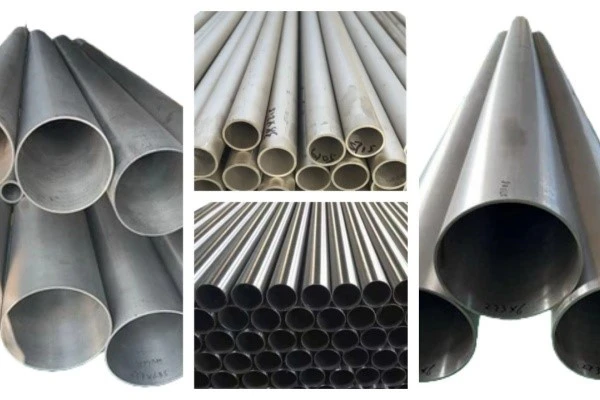
Ruihang supplies optimal quality raw materials for your precision components production. If you have any purchasing needs, please contact us via email:Sam.Rui@bjrh-titanium.com