

Titanium Tube Working‑Condition Application And Standardized Operation & Maintenance
Sep 23, 2026
Leave a message

Compared with stainless steel and carbon steel, titanium tubes exhibit minimal corrosion under harsh media such as chloride ions, strong acids and strong alkalis. Nevertheless, to sustain their performance advantages over the long term, matching working conditions, standardized installation & operation‑maintenance, and meticulous maintenance are required.
I. Core Material Properties of Titanium Tubes and Fundamentals of Working‑Condition Matching
1. Core Advantages
The surface of pure‑titanium / titanium‑alloy tubes spontaneously forms a dense and stable titanium‑dioxide passivation film, which can rapidly self‑repair upon damage. Titanium tubes resist electrochemical corrosion, pitting corrosion and crevice corrosion, and deliver far superior performance to ordinary stainless steel in high‑chlorine seawater, salt‑spray and acid‑alkali environments. Titanium has a density merely 60 % that of steel yet strength comparable to high‑quality carbon steel, achieving both lightweight design and structural strength. It also possesses favorable high‑ and low‑temperature performance with stable mechanical properties ranging from ‑50 ℃ to 300 ℃.
2. Grade Selection
- Pure Titanium Tube: Cost‑effective. Suitable for weak‑acid environments, seawater cooling, and clean corrosive service at ambient temperature.
- Titanium‑Molybdenum Alloy Tube: Excellent resistance to reducing corrosion. Applied in high‑temperature sulfuric‑acid, wet‑process desulfurization, chlor‑alkali and other highly corrosive working conditions.
- Titanium‑Palladium Alloy Tube: Optimal passivation capacity. Deployed in high‑purity chemical media, precision heat exchange and other high‑end scenarios.
3. Tube Types and Standards
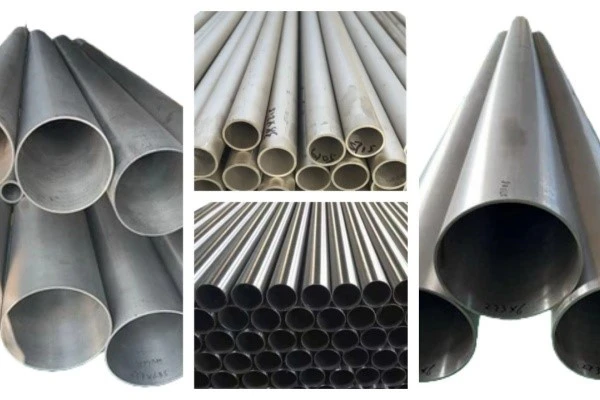
Titanium tubes are classified as seamless titanium tubes and welded titanium tubes. Seamless tubes are preferred for main pipelines under high‑temperature, high‑pressure and heavily corrosive service; qualified welded tubes can be adopted for low‑pressure auxiliary pipelines at ambient temperature. Selection shall comply with standards including ASTM B338, B861 and B862.
II. Typical Industrial Application Scenarios of Titanium Tubes and Key Selection Points
1. Corrosive Chemical‑Process Conditions
brine and evaporation pipelines in chlor‑alkali ion‑membrane caustic‑soda units exposed to high‑temperature caustic soda and chloride ions, Gr2 and Gr12 titanium tubes deliver long‑term corrosion resistance.
high‑temperature acetic‑acid service of PTA plants, Gr2 seamless titanium tubes prevent intergranular corrosion and guarantee medium cleanliness.
liquid from Flue‑Gas Desulfurization (FGD) contains acids and chloride ions. Gr12 seamless titanium tubes are prioritized for spray and main circulation pipelines to withstand corrosive reducing acids.
2. Ocean Engineering and Seawater‑Desalination Conditions
tubes are used for seawater‑cooling, fire‑protection and auxiliary oil‑gas pipelines on offshore platforms. Resistant to chloride‑ion corrosion, they achieve a service life exceeding 30 years, outperforming stainless steel.
seawater‑desalination facilities: Gr2 welded titanium tubes are available for heat‑exchange and water‑transport sections under low‑temperature low‑pressure service; Gr12 titanium tubes are selected for high‑temperature high‑pressure concentrated‑seawater sections to balance performance and cost and avoid product‑water contamination.
3. Power‑Generation and Thermal Heat‑Exchange Conditions
Cooling and waste‑heat‑recovery systems in thermal‑power, nuclear‑power and new‑energy power stations feature high temperature, high pressure, scaling and trace corrosive media. Titanium heat‑exchange tubes prevent leakage caused by stress corrosion, maintain stable thermal conductivity and preserve heat‑exchange efficiency. Flue‑gas waste‑heat pipelines suffer large temperature fluctuations together with sulfur‑ and nitrogen‑oxide species; titanium tubes resist high‑temperature oxidation and acid corrosion and enhance system reliability.
4. Metallurgy and Special‑Industry Conditions
Electrolytes in hydrometallurgy consist of strong acids mixed with heavy‑metal salts, bringing both corrosion and particle‑induced erosion. Titanium tubes serve electrolyte‑transport and circulation pipelines for copper, nickel and cobalt smelting. In pharmaceutical, precision‑electronics and other high‑purity sectors, titanium tubes produce negligible heavy‑metal leaching and are easy to clean. They are applicable for high‑purity‑reagent and sterile heat‑exchange processes and satisfy strict hygiene requirements.
III. Standardized Operation‑Maintenance System Framework for Titanium Tubes
1. Pre‑Installation Quality Control
Verify grade and specification of incoming materials, and conduct non‑destructive testing and hydrostatic testing. Reject non‑conforming products. Employ dedicated tools during construction of titanium tubes and isolate carbon‑steel components to avoid iron contamination and surface scratches. Apply argon‑arc welding or plasma welding with inert‑gas shielding, and perform post‑weld non‑destructive inspection. Arrange pipelines in accordance with design specifications, control pipeline gradient, supports and mechanical stress to prevent deformation and leakage.
2. Routine Inspection
Implement daily and weekly inspections. Monitor medium temperature, pressure and flow velocity; operation beyond rated working conditions is strictly prohibited. For particle‑laden media, control flow velocity and inspect filters. Check appearance, leakage and vibration of tubes, welds, flanges and supports. For heat‑exchange tubes, monitor temperature difference and heat‑exchange efficiency. File all inspection records.
3. Periodic Inspection and Condition Assessment
Establish quarterly / annual inspection plans according to service conditions: full‑scale inspection every six months for general service, and special quarterly inspection for high‑temperature, high‑pressure and heavily corrosive service. Inspect wall thickness, weld joints, passivation films, scaling and residual stress. Classify equipment status into three levels: normal condition, warning condition and shutdown‑for‑maintenance condition, and execute corresponding operation‑maintenance measures.
Ruihang supplies optimal quality raw materials for your precision components production. If you have any purchasing needs, please contact us via email:Sam.Rui@bjrh-titanium.com