

Why Is Titanium Replacing Steel As The Robot Skeleton For Embodied Intelligence?
Oct 27, 2026
Leave a message

Human-oriented artificial intelligence needs physical bodies to step out of the virtual world and into reality. Built with titanium-alloy skeletons, servo drives and perception systems and empowered by embodied intelligence, titanium-framed humanoid robots feature human-like appearances, agile movements and high environmental tolerance. They reshape interaction patterns among robots, humans and surroundings.
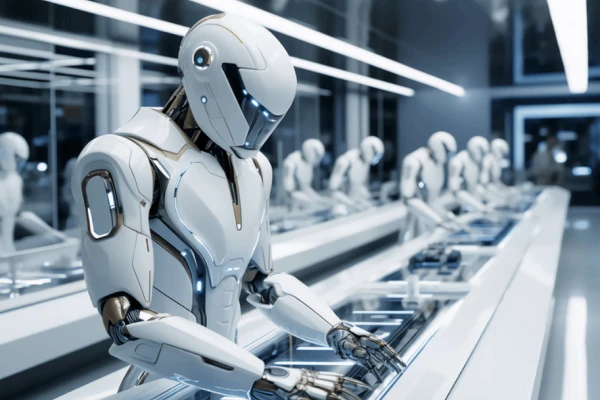
I. Titanium-Alloy Robot Skeleton
1.Superior specific strength of Grade 5 Titanium Alloy
Its density is about 60% that of steel while its strength approximates high-strength steel. It balances lightweight performance and structural safety, outperforming heavy steel and aluminum alloys with inferior fatigue resistance.
2.Notable weight-reduction benefits
It eases joint load, lowers motor burden, cuts energy consumption and boosts battery life. It also delivers faster motion response and more stable walking.
3.Fatigue resistance and environmental durability
Its fatigue life is roughly three times that of stainless steel. With corrosion resistance and wide high-low-temperature tolerance, it suits special-condition work environments featuring humidity, acid-alkali substances and dust.
II. Structural Design of Titanium-Alloy Robots
- Titanium alloy serves as the load-bearing skeleton for force-bearing core components: hip/knee/ankle reducer housings, transmission gears, spinal support frames and dexterous finger bones. Forging, precision machining and 3D-printed hollow structures are adopted to reduce weight along force-transfer paths.
- Carbon fiber and lightweight engineering plastics are applied to outer shells and non-load-bearing brackets to strike a balance among cost, weight and strength.
- Precision titanium-alloy machining enables compact joints, allowing embedded installation of multiple sets of sensors and transmission parts. Supporting dozens of degrees of freedom, robots can perform human-like motions including walking, climbing, gripping and fine manipulation, balancing output force and dexterity.
III. Application Scenarios
1.High-risk scenarios
Equipped with thermal imagers, gas sensors and LiDAR, robots are deployed for fire-rescue search, chemical-leakage inspection, underground survey and high-altitude maintenance. They venture into toxic, high-temperature and collapse-prone zones instead of humans to collect environmental data, transfer materials and defuse hidden dangers, shielding humans behind metallic shells.
2.Industrial manufacturing
Performing assembly, quality inspection and material handling to adapt to multi-variety flexible production.
3.Healthcare and caregiving
Leveraging the favorable biocompatibility of titanium alloy to assist rehabilitation training and provide companion care.
4.Household services
Performing housework and companion care to act as reliable collaborative partners for humans.
IV. Practical Challenges
1.Developmental bottlenecks
- Cost: High prices of titanium-alloy raw materials and precision machining, plus difficulties in forming complex components hinder large-scale adoption.
- Core supporting components: Servo motors, reducers, batteries and large-model control algorithms determine robot performance in movement, gripping and instruction comprehension.
- Cost-reduction pathways - Optimize additive manufacturing, iterate material formulas and adopt modular joint designs to turn titanium alloy from a prototype-exclusive material into a mass-production standard configuration.
2.Positioning and value
- Not omnipotent sci-fi mechanical beings, but tools for expanding human capabilities.
- Titanium skeletons adapt to hazardous scenarios while intelligence handles perception and comprehension. Rather than replacing humans, robots undertake work that humans are unwilling, unable or ought not to do.
- Titanium-framed humanoid robots represent the integration of materials science and artificial intelligence. Lightweight yet high-strength titanium skeletons underpin embodied intelligence, enabling robots to move beyond laboratories and land in real-world settings such as factories, disaster sites and cities.

Ruihang, as a direct manufacturer of titanium products, supply optimal quality titanium products for your precision components production.We respond within 24h, offer reliable top-grade products and full after-sales support for your total satisfaction. For more details, please feel free to contact us via email: Sam.Rui@bjrh-titanium.com