

What Are The Characteristics Of Cold-Working Process For Titanium Alloy Bars And Wires?
Oct 14, 2026
Leave a message

The crystal-structural characteristics of titanium alloys result in far higher cold-working difficulty compared with ordinary carbon steels and copper alloys. For α-type and α+β-type titanium alloys (Grade 1, Grade 5), the number of operable slip systems at room temperature is limited; deformation readily generates twins and leads to a high work-hardening rate. Although β-type titanium alloys possess relatively superior cold formability, dislocation tangling and texture strengthening still occur under large deformation. Improper selection of cold-working parameters may easily cause wire breakage, surface scratching, residual-stress-induced cracking, excessive mechanical property anisotropy and other defects.
I. Basic Cold-Working Processes and Process Characteristics of Titanium Alloy Bars and Wires
1. Process Principles
Cold drawing: The blank is pulled through a die under external force to realize diameter reduction and elongation.
Cold rotary swaging: High-frequency radial hammering by hammers, suitable for precision diameter reduction of large-size bars.
Cold rolling: Forming via compression of rolls, mostly applied to special-shaped parts and small-to-medium-sized wires.
2. Material Features
Pronounced work hardening. The single-pass area reduction ranges from 10% to 20%. Excessive deformation causes material fracture and die sticking. α+β titanium alloys exhibit stronger hardening, while β titanium alloys deliver better cold plasticity.
Titanium has high surface activity and is prone to cold welding and die sticking. Special solid lubricants and blank pre-treatment are required; steel-oriented lubrication schemes cannot be directly adopted.
Cold deformation produces wire texture and brings about anisotropic mechanical properties. Annealing can only weaken texture rather than eliminate it completely.
Non-uniform deformation leaves residual tensile stress, impairing corrosion resistance and fatigue performance. Intermediate stress-relief annealing shall be adopted for multi-pass processing.
II. Effects of Cold-Working on Microstructure Evolution of Titanium Alloy Bars and Wires
1. Grains
Original equiaxed grains are elongated to form fibrous microstructures. Under large deformation, elongated grains fragment and generate deformation subgrains. Besides slip, hexagonal close-packed (HCP) α-phase develops deformation twins, which segment grains and hinder dislocation motion.
2. Dislocations
Cold deformation increases dislocation density and produces dislocation tangles, dislocation cells and subgrains, which constitute the core mechanism of cold-working strengthening.
3. Phases
Deformation of α-titanium alloys is realized by slip and twinning of α-phase. Cold deformation of metastable β-titanium alloys may trigger β→α'' martensitic transformation, which affects strength and elasticity. Stable β-titanium alloys deform mainly by dislocation slip of β-phase and hardly undergo phase transformation.
III. Influence Rules of Cold-Working Process Parameters on Mechanical Properties
1. Total Cold Deformation
Increased cold deformation raises the strength and hardness yet reduces the plasticity of titanium alloys.
Low cold deformation: Weak work hardening, slight strength increment, favorable plasticity, low residual stress and mild texture. Suitable for high-plasticity fastener wires.
Moderate cold deformation: Increased strength and decreased elongation; fibrous microstructure and obvious texture are formed. This is the common process route for high-strength titanium wires.
Large cold deformation: Massive multiplication of dislocations leads to substantial strength improvement, accompanied by deteriorated plasticity and increased brittleness, as well as prominent residual stress and texture. It is only adopted for a small number of high-strength and high-elasticity components, and finished products require sufficient stress-relief annealing.
2. Pass Allocation and Intermediate Annealing
Given fixed total deformation, drawing or rolling passes affect product yield and property uniformity. Large single-pass deformation easily causes stress concentration and surface cracks. Multi-pass small-strain deformation combined with intermediate annealing relieves work hardening, facilitates forming and yields more uniform material properties.
Recovery annealing: Eliminates residual stress and partially restores plasticity with little strength reduction, mainly used for stress relief of finished products.
Recrystallization annealing: Fully softens materials for subsequent cold drawing. Excessively high temperature or prolonged holding time causes grain coarsening, which degrades strength and fatigue performance. Annealing of titanium alloys shall be performed under vacuum or inert atmosphere to prevent hydrogen and oxygen absorption, avoiding hydrogen embrittlement and toughness deterioration.
3. Surface Quality and Service Performance
Scratches, pits and micro-cracks induced by cold-working tend to initiate fatigue fracture and stress corrosion. The fatigue performance of titanium bars and wires is highly sensitive to surface defects. Optimized lubrication and die condition control improve surface state and extend fatigue life. Even minor surface defects can markedly reduce fatigue strength.
IV. Common Cold-Working Defects and Control Strategies
|
Defect |
Main Causes |
Control Countermeasures |
|
Wire breakage during drawing |
Excessive single-pass deformation, accumulated work hardening, surface defects of blanks, lubrication failure, hydrogen embrittlement |
Reduce single-pass reduction; increase intermediate annealing; polish blanks to remove surface defects; strictly control hydrogen content |
|
Surface scratching and peeling |
Cold welding and die sticking between titanium and dies |
Optimize blank surface coating; adopt cemented-carbide dies; control die cone angle and surface finish |
|
Residual-stress-induced cracking |
Excessive residual tensile stress after multi-pass deformation |
Implement intermediate stress-relief annealing; control cooling rate |
|
Excessive property anisotropy |
Intense deformation texture |
Reasonably control total deformation; optimize annealing regime; adjust initial blank texture if necessary |
References
[1] Zhou Zongyi. Development Status and Strengthening Methods of High-Strength β-Titanium Alloys[J]. Journal of Beijing University of Technology, 2022.
[2] Sun Xiaoping. Microstructure and Texture Evolution Mechanism of Titanium Alloys under Synergistic Regulation of Rolling-Drawing-Annealing-Cooling[J]. Rare Metal Materials and Engineering, 2025.
[3] Dong Jie. Effects of Manufacturing Processes of High-Plasticity TC4 Titanium Alloy Medical Bars on Microstructure and Properties[J]. Metal World, 2021.
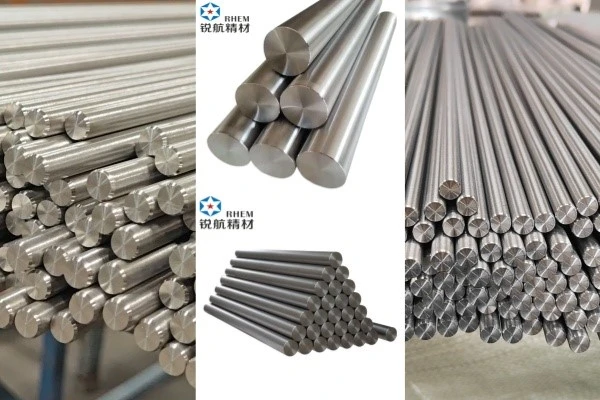
Ruihang, as a direct manufacturer of titanium products, supply optimal quality raw materials for your precision components production. If you have any purchasing needs about titanium alloy bars/plates, please feel free to contact us via email:Sam.Rui@bjrh-titanium.com